 Book an appointment online
Definition, Indications, Objectives and Principles
Lipofilling, liposculpture, or autografting of fatty tissue is a technique that involves taking small amounts of fat from the patient's body and reinjecting it to fill hollows caused by dark circles, scars, depressions, or to reshape a face.
Lipofilling is a concept developed in the mid-1980s by Dr. Fournier, a pioneer of liposuction.
It was primarily from 1995 onwards that autologous fat transfer, also called lipostructure, became a truly reliable method (S. Coleman). The principle is to perform a genuine autograft of fat cells by reinjecting fat harvested from the patient themselves.
Fat is harvested from various parts of the body, primarily the inner knees and thighs or the abdomen, and then injected in small quantities into the target area at two or three depths (periosteum, muscles, and hypodermis). This procedure offers several advantages: no allergic reactions, correction of significant volume, and improvement of the skin's elasticity. However, superficial fine lines cannot be treated with this technique and must be addressed with other injectables.
Lipostructure can be applied to a large number of natural or post-traumatic depressions (hollows); the objectives and indications for this type of intervention can be summarized as follows:
AESTHETIC INDICATIONS
- Filling and reducing certain wrinkles, particularly on the face;
- Restoring facial volume and shape: this may include restoring a face emaciated by aging or significant weight loss;
- An addition associated with certain cervico-facial lifts to improve facial harmony or rhinoplasty at the level of the nasolabial folds;
- Secondarily, after a first facelift , to improve the contour of the middle third of the face without having to resort to a new facelift.
INDICATIONS IN RECONSTRUCTIVE AND REPAIR SURGERY
- Filling a tissue depression following trauma;
- Correction of fat loss after triple therapy in HIV+ patients.
Pre-operative consultations
The first consultation allows the surgeon to become aware of the patient's expectations as well as the aesthetic and psychological impact of the problem.
The consultation begins with an examination of the patient's motivations.
An interview about medical and surgical history is essential.
The surgeon then examines his patient to assess the patient's request, its feasibility, and the quality of the skin.
It is essential to carry out a meticulous clinical and photographic study of the corrections to be made, particularly in terms of facial rejuvenation lipostructure ; it will be necessary to have studied, on photographs from youth, compared to the current state, the modalities of aging.
This thorough examination allows the surgeon to offer the patient a technique adapted to their case and to specify the modalities of the intervention, the type of anesthesia, local or assisted local.
Certain associated procedures such as cervical liposuction can be discussed.
A photographic assessment is then carried out.
The patient will be fully informed about the usual postoperative course and potential complications. They will then be given a detailed information sheet about the planned procedure to further inform them and allow them to make a considered decision at their leisure.
The surgeon's and anesthesiologist's fees will be specified, and a quote outlining all anticipated costs will be provided to the patient.
The second consultation allows for personalized answers to any questions the patient may have. A further clinical examination will validate the initially proposed treatment plan and allow for planning based on the photographic assessment.
In preparation for anesthesia ( local with sedation or local only), certain preoperative blood tests and an anesthesiologist consultation are often required. No medication containing aspirin should be taken for 10 days prior to the procedure.
The quote will be discussed again and signed by the practitioner and the patient.
The intervention
TYPE OF ANESTHESIA
Lipostructure is usually performed under deep local anesthesia with intravenous tranquilizers (conscious sedation). Simple local anesthesia or even general anesthesia can also be used.
The choice between these different techniques will be the result of a discussion between you, the surgeon and the anesthesiologist.
HOSPITALIZATION PROCEDURES
This surgery is almost always performed on an outpatient basis, with admission and discharge taking place on the same day.
Patients must arrive at least one hour before their scheduled procedure and have fasted for six hours. Discharge typically occurs three to five hours after the procedure is completed.
You must be accompanied on your return home and not be alone the night following the procedure.
THE INTERVENTION ITSELF
The procedure begins with the identification of the fat harvesting areas as well as the reinjection sites.
The removal of fatty tissue is carried out atraumatically through a micro-incision hidden in the natural folds, using a very fine suction cannula, in an area where there is a reserve or excess of fatty tissue.
.jpg)
.jpg)
Adipose tissue sampling: Centrifugation, Colemann method
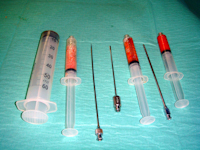
Next, a centrifugation of a few minutes is carried out to separate the intact fat cells, which will be grafted, from the elements that are not graftable.
.jpg)
Sampling cannulas and syringes: Appearance after centrifugation
The reinjection of fatty tissue is done through incisions of less than 1 mm using micro-cannulas.
Injecting mini fat lobules in different planes and in multiple divergent directions will ensure the survival of the grafted fat cells.
The grafted cells will remain alive within the body, making the lipostructure technique a permanent one since the fat cells will live as long as the tissues around them.
The injection points are closed with a dressing or an absorbable stitch, they are located in a fold.
The duration of the procedure depends on the amount of fat to be reinjected and the number of areas to be treated, on average 30 minutes, another procedure can be combined at the same time.
Post-operative care and follow-up
POST-OPERATIVE CARE
This is a painless procedure.
Tissue swelling (edema) appears for 48 hours following the procedure and will generally take 5 to 15 days to be completely resolved.
Bruising may appear in the first few hours at the fat injection sites or the donor sites; these will disappear within 10 to 20 days after the procedure. It is these hematomas that may pose a problem for immediately resuming social activities.
The operated areas should not be exposed to the sun or UV rays for at least 4 weeks, as this would imply the risk of permanent pigmentation.
THE RESULT OF LIPOFILLING
It is assessed within three to six months after the intervention.
However, the result may gradually deteriorate due to the natural continuation of aging in these same tissues.
The injection of fat cells not only fills a depression but also improves the quality of the skin in the area of the injection by providing tissue growth factors.
Post-operative concerns and complications of lipofilling
IMPERFECTIONS IN THE RESULT
In some cases, localized imperfections may be observed (without constituting real complications): localized insufficient correction, slight asymmetry, irregularities.
They are, as a general rule, accessible to additional treatment: a small "touch-up" of lipostructure under simple local anesthesia from the sixth postoperative month to perfect the result.
POSSIBLE COMPLICATIONS
Liposuction is a real surgical procedure, which implies the risks associated with any medical procedure, however minor.
Complications from anesthesia are always possible, even if it is light and brief.
Such a procedure must absolutely take place in a surgical operating room.
Infection is normally prevented by prescribing antibiotic treatment during and after surgery.
Overcorrection: the most frequent complication after fat grafting, it is linked to the reinjection of an excessive amount of fat and results in overcorrection, leading to excess volume that can be aesthetically displeasing. Most often, only a second procedure with true surgical removal of the excess fat will correct an overcorrection.*
We should not overestimate the risks, but simply be aware that a surgical procedure, even one that seems simple, always involves a small element of risk;
True complications are exceptional; great rigor in determining the indication and performing the surgery should ensure, in practice, effective and real prevention, in particular the use of blunt cannulas which respect the skin, vessels and nerves.
Examples of results
Treatment of a scar with skin atrophy
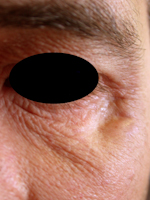
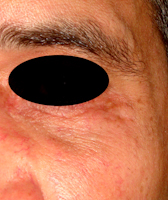
Scar with skin atrophy. Appearance after injection, filling of the depression and improvement of the skin quality in the surrounding area.
Treatment of surgical and radiotherapy sequelae
Sequelae of extensive surgery with radiotherapy
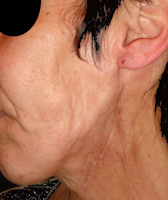
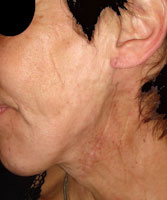 Six months after a lipofilling session, additional injections can be scheduled.
.jpg) |
.jpg) |
| Pre-operative appearance | Pre-operative appearance |
.jpg) |
.jpg) |
| Post-operative appearance | Post-operative appearance |
Treatment of localized lipoatrophy
.jpg)
.jpg)
.jpg)
Pre-operative appearance of pre-malar lipoatrophy
.jpg)
.jpg)
.jpg)
Appearance 6 months post-operative
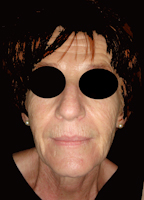
comprehensive facial treatment
.jpg)
.jpg)
.jpg)
Pre-operative appearance
.jpg)
.jpg)
.jpg)
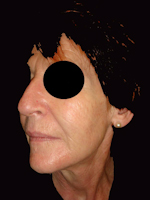
Post-operative appearance

