Book an appointment online
Due to its proximity, function, and innervation by the trigeminal nerve, the temporalis muscle is an ideal material for restoring dynamic lip tone. Numerous techniques have been described in the literature (3, 4, 5, 6).
Temporal muscle transposition is the cornerstone of the treatment, which must also include management of the unaffected side. Transposition of the posterior head of the temporalis muscle is a reliable technique, validated by our team for many years: via a coronal approach, the temporalis muscle is exposed. Its posterior portion is freed, and the muscle belly is incised along the direction of the fibers.
The zygomatic arch is sacrificed, a subcutaneous cheek tunnel is created. The distal part of the posterior head of the temporalis muscle is anchored to the orbicularis oris muscle either by an incision in the nasolabial fold (when this is marked on the contralateral side), or by an intraoral incision (figure 3).
Figure 3:
Transposition of the posterior head of the temporalis muscle
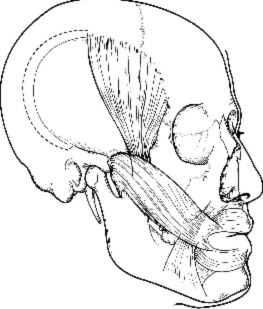
The coronal approach (in the hair) allows for simultaneous frontal myectomies on the healthy side and an external canthopexy to tighten the eyelid strap on the paralyzed side.
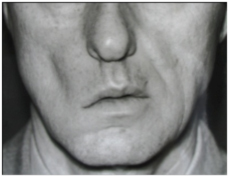
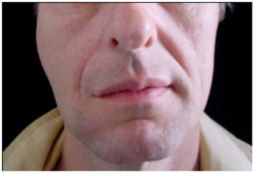
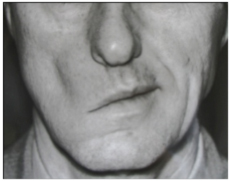
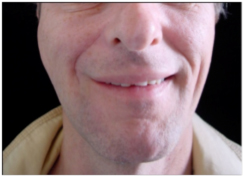
Rehabilitation of the paralyzed smile
Before and after